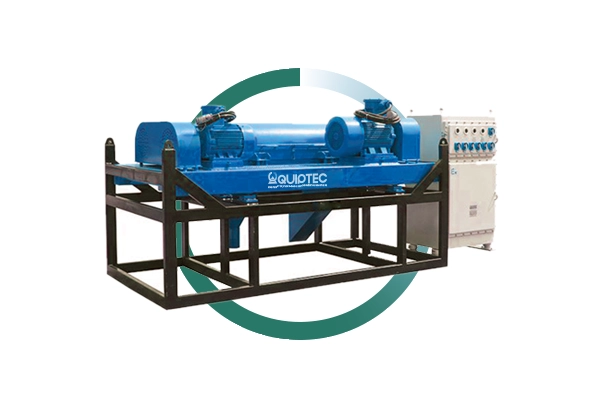
Preliminary sizer for wastewater, sludge, NDD mud and mineral slurry duties. Selection from
9 AQUIPTEC AQT-LW / GLW models uses separate actual and design mass balances,
hydraulic and provisional DS capacity, cut-point, G-factor and duty/standby firm capacity.
Returns CUSTOM ENGINEERING REQUIRED if no configuration meets all criteria.
SI units · 9 models · 548–2 253 G · 2–7 µm cut · EPA Biosolids Tech Fact Sheet · M&E §14 · Perry Ch. 18
v4.1 engineering corrections:(1) operating mass balance separated from selection SF
(2) density-based cake and centrate balance
(3) actual polymer consumption
(4) duty + standby and N+1 firm-capacity check
(5) installed-weight / energy-based configuration ranking
(6) provisional DS capacity retained and clearly identified
📖 How to use this calculator — 10-step procedure & important notes (click to expand)
Step-by-step procedure
Select a source preset, then replace assumptions with representative project data.
Enter actual Q and TS. TS is g/L, numerically equal to kg DS/m³.
Set the equipment safety factor, target cut-point and minimum G. SF applies to selection duty only.
Set feed and centrate densities for the wet mass balance; check cake density and cake DS.
Set the provisional solids-capacity basis and derate. These are screening estimates, not vendor guarantees.
Enter minimum duty, standby and maximum installed units. N+1 passes only if firm capacity remains adequate with one unit unavailable.
Choose Capex or Energy/right-sized ranking. The alternative configuration remains visible.
Review hydraulic, DS, separation and G eligibility and the identified governing capacity constraint.
Review actual cake, centrate, polymer and daily operating quantities.
Obtain vendor and pilot confirmation before quotation: kg DS/h, torque, differential speed, pond depth, beach angle, vibration and polymer optimisation.
Important notes
Provisional DS capacity is not vendor-guaranteed. Replace it with a sludge-specific vendor capacity matrix for commercial selection.
Capture, cake DS and polymer dose are performance assumptions requiring representative testing.
Two required duty machines are not N+1. Standby machines are entered separately.
Cut-point and G are screening filters. Separation performance also depends on particle density, size distribution, viscosity, differential speed, torque and pond settings.
Actual mass balance excludes the equipment SF. Design flow and DS include SF only for capacity selection.
 Decanter Centrifuge — Sizer (v4.1 engineering revision)